Support Operations · Escalation Systems · 2026

Engineering Escalation Engine

A working Support Operations prototype that standardises how complex cases move from investigation to Engineering. It combines AI-assisted evidence analysis, deterministic escalation scoring, human approval and structured engineering handoffs.

Live demo available with fictional enterprise cases and simulated downstream integrations.

Complex support cases often reach Engineering with very different levels of evidence. One escalation may include reproducible steps, logs, affected customers, and a clear product signal. Another may still have unresolved configuration questions or missing technical data.

That creates friction on both sides. Support needs a consistent way to decide when a case is actually ready to escalate, while Engineering needs a handoff that contains enough evidence to act on.

I built the Engineering Escalation Engine to create a more structured path from support investigation to engineering handoff, while keeping final escalation authority with a human reviewer.

I designed and built the prototype end to end, translating patterns from my experience handling enterprise P1 and P2 escalations into a structured workflow. I defined the case lifecycle, escalation signals, scoring rules, human decision boundary, API and persistence model, then implemented the application in Next.js, TypeScript and Supabase/Postgres.

The system moves each case through structured intake, investigation, AI-assisted analysis, deterministic assessment and human review. Approved cases generate an engineering-ready handoff with an audit trail, while incomplete cases remain in investigation.

The goal is not to automate judgement away from Support. It is to make escalation quality more consistent, preserve evidence provenance and make the distinction between “this is serious” and “this is ready for Engineering” explicit.

01Case intake
02Investigation
03AI analysis
04Rules-based assessment
05Human decision
06Engineering handoff
AI analyses. Rules recommend. Humans decide.

AI output is advisory. The escalation score is calculated by predefined rules and validated signals, and an authorised reviewer makes the final escalation decision.

20

Insufficient evidence

Missing reproduction and incomplete technical evidence keep the case below the investigation threshold.

58

Continue investigation

Production impact is confirmed, but unresolved configuration questions make escalation premature.

98

Escalate

Validated reproduction, multi-customer impact and a suspected product defect make the case ready for Engineering.

01

One queue, different outcomes

The dashboard shows that severity alone does not determine escalation. Each case carries its own evidence state, recommendation and workflow status, distinguishing cases that need more investigation from cases ready for Engineering.
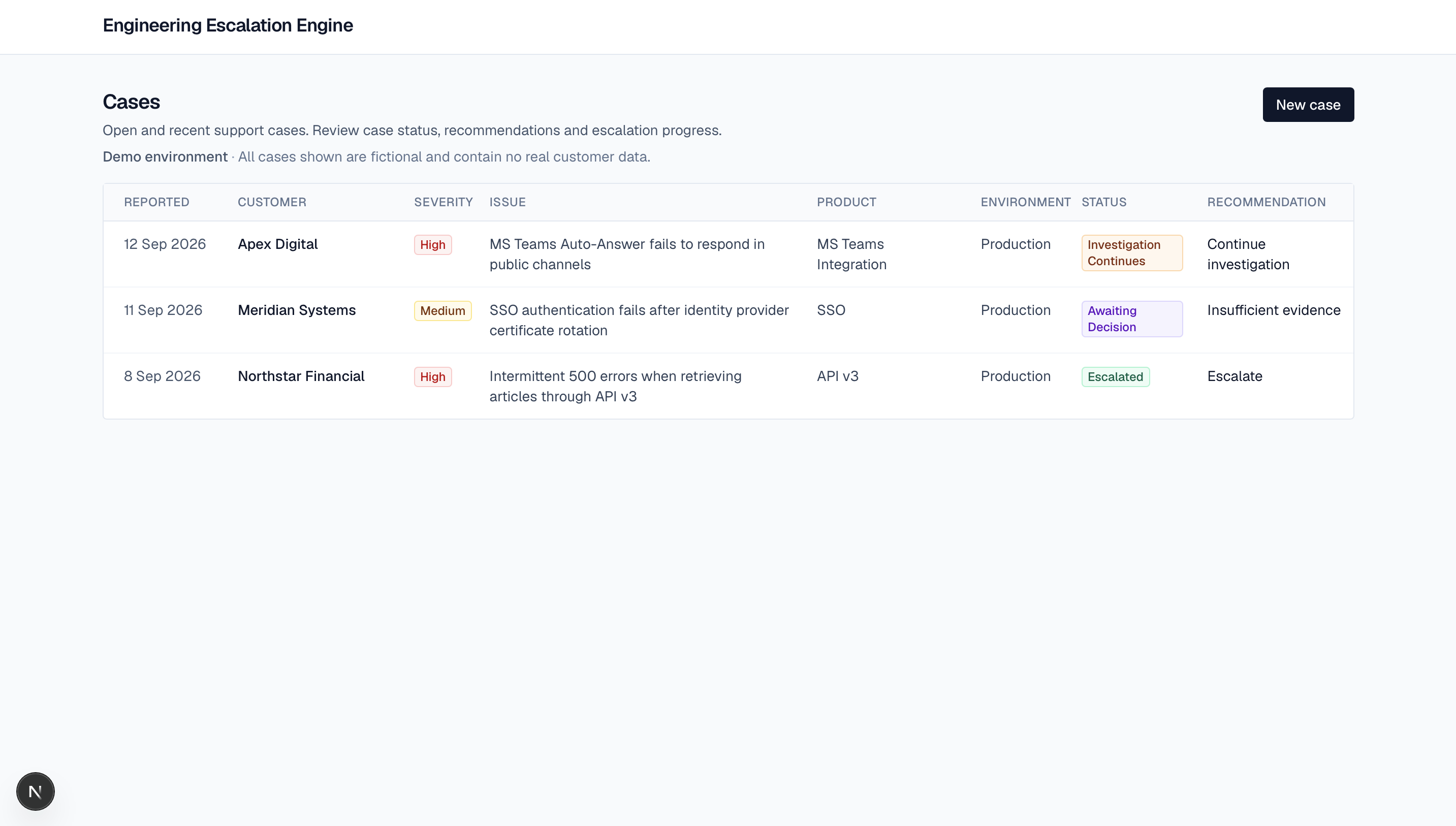
Engineering Escalation Engine dashboard showing three fictional cases with different workflow outcomes
Three fictional cases demonstrate insufficient evidence, continued investigation and escalation.
View full size ↗
02

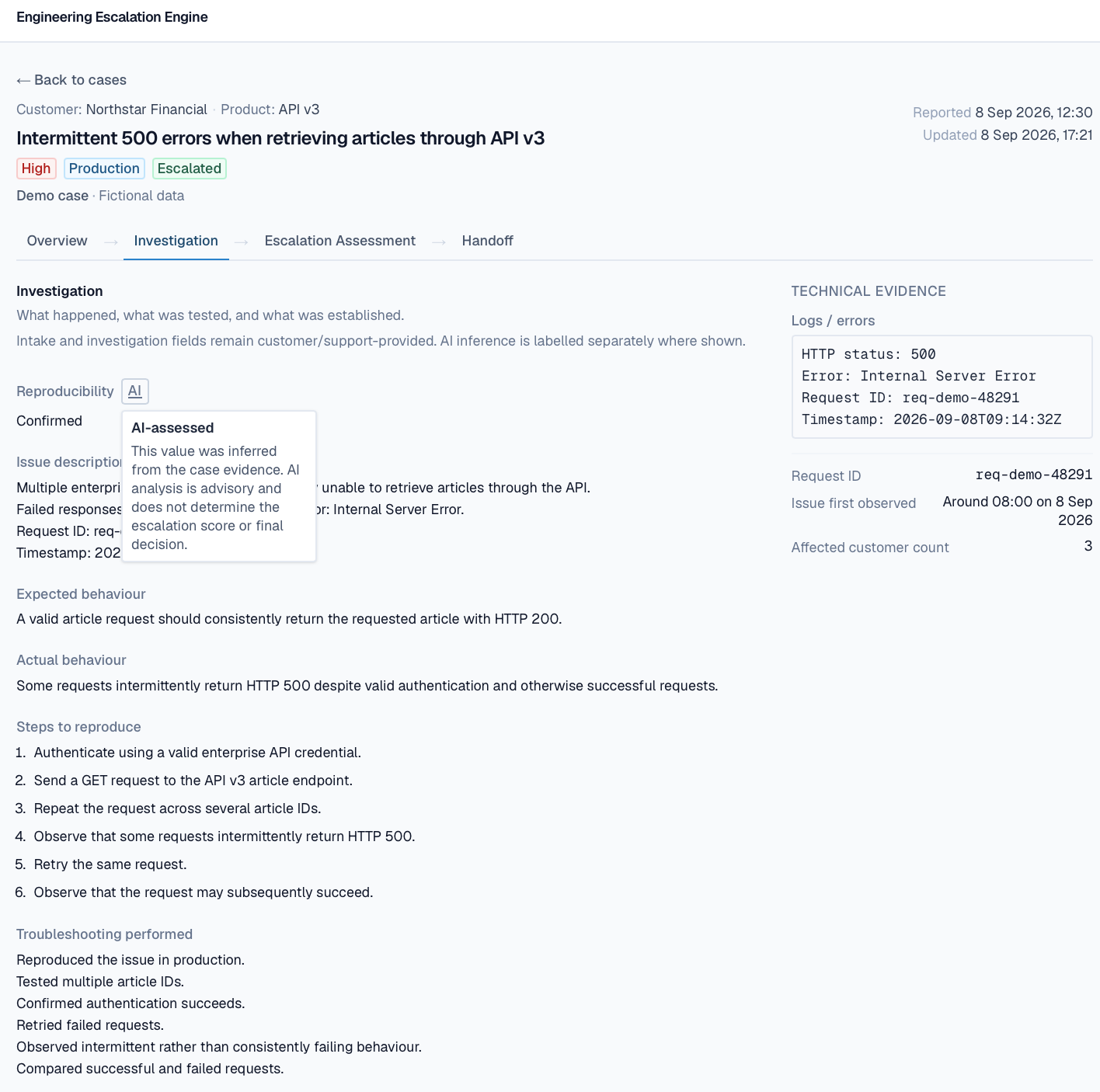
Evidence before escalation

Customer and support-provided evidence remains distinguishable from AI-inferred fields. The AI badge makes clear that analysis is advisory rather than authoritative.

Investigation view showing technical evidence and labelled AI-assessed reproducibility
Inferred values are labelled while the underlying customer and support evidence remains inspectable.
View full size ↗
03

Deterministic escalation assessment

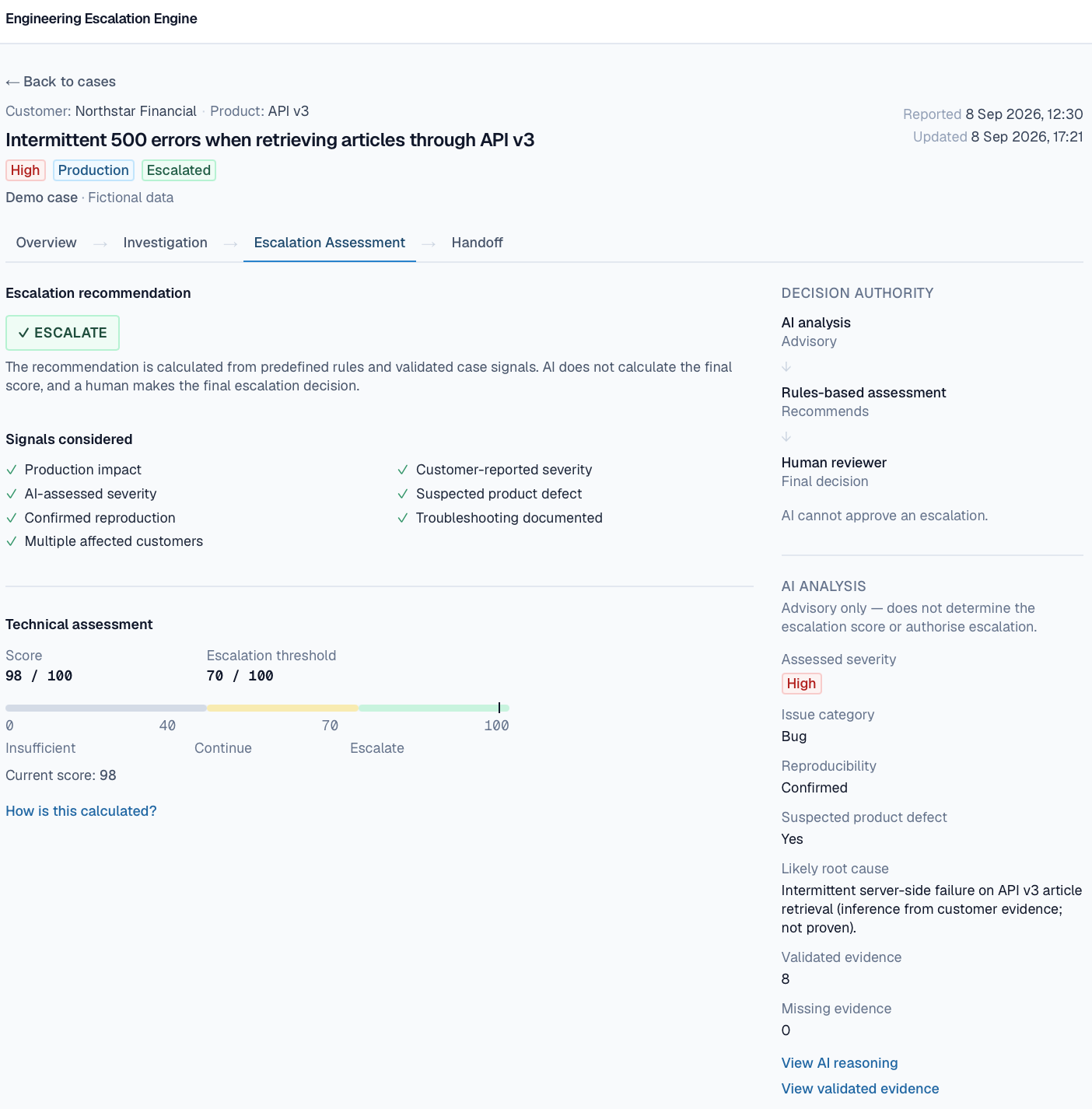
Northstar reaches 98/100 against a 70-point threshold. The rules engine evaluates validated signals including production impact, confirmed reproduction, affected customers and suspected product defects.

Escalation assessment showing a 98 out of 100 score and Escalate recommendation
AI analysis remains visible, but deterministic rules produce the score and recommendation.
View full size ↗
04

Knowing when not to escalate

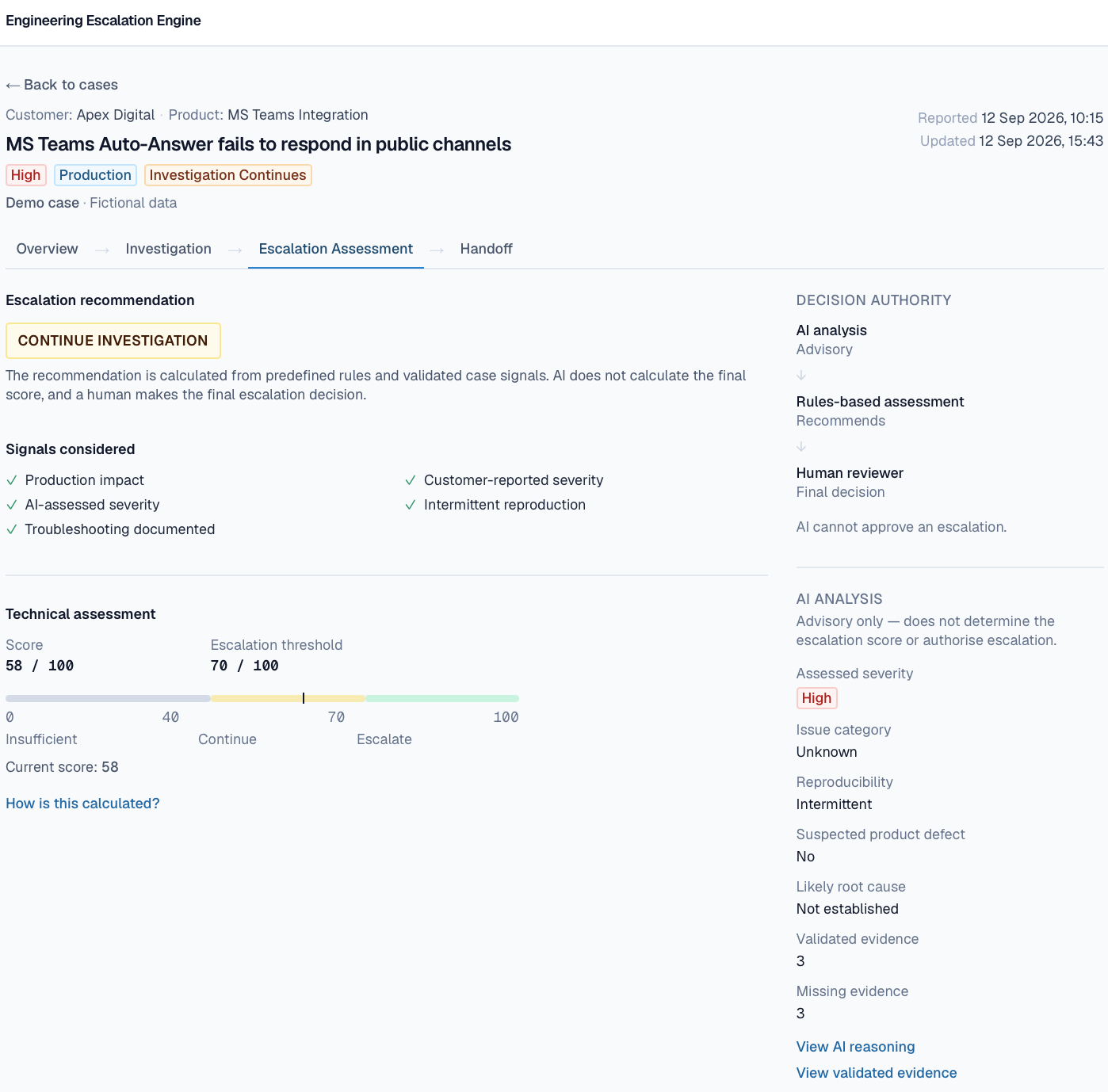
Apex is high severity and production-impacting, but unresolved permissions and configuration questions remain. Its 58/100 score keeps the case in investigation rather than creating a premature handoff.

Escalation assessment showing a 58 out of 100 score and Continue Investigation recommendation
High severity does not automatically mean escalation. Evidence quality and reproducibility still matter.
View full size ↗
05

From Support to Engineering

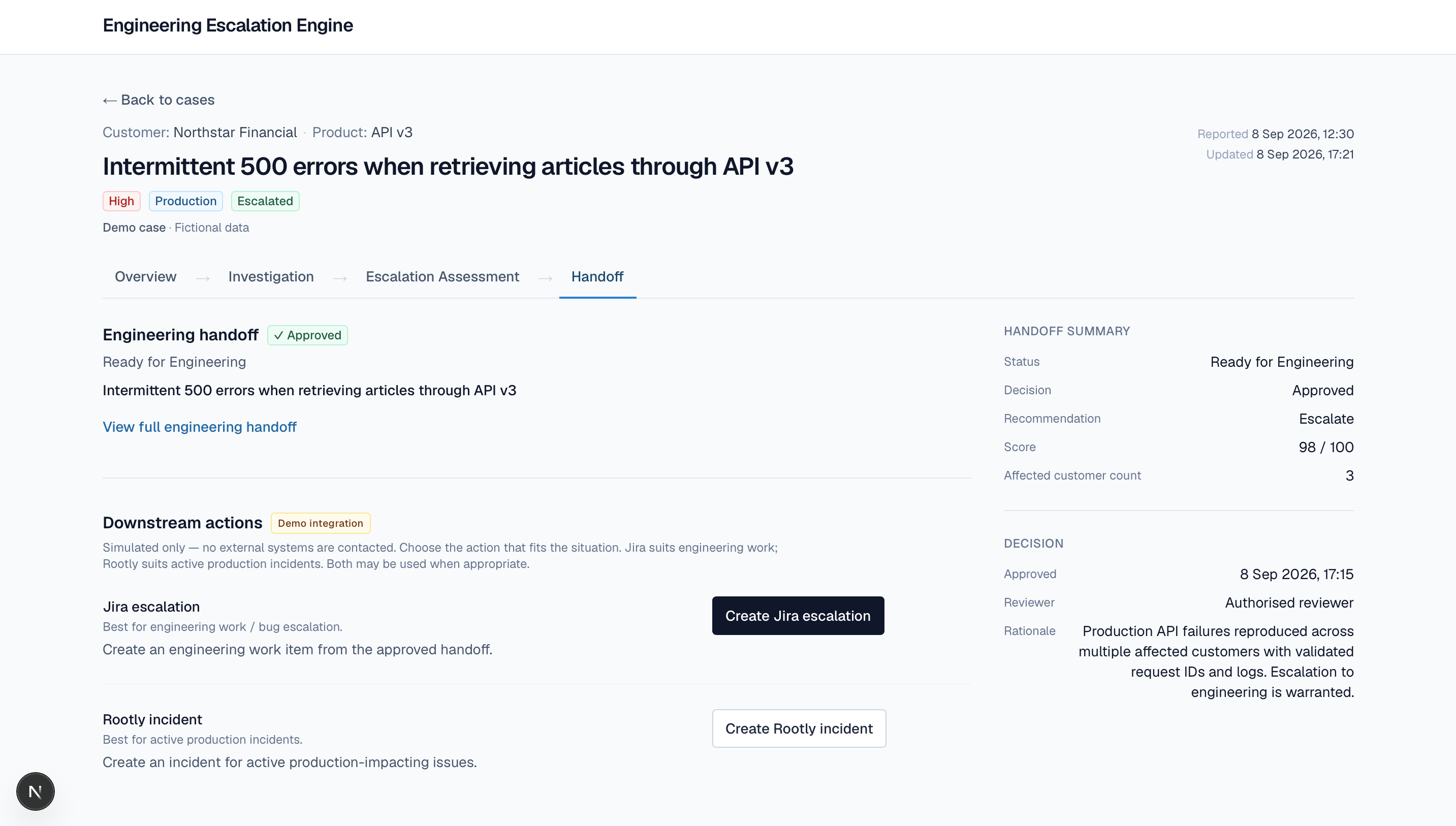
Human approval creates an engineering-ready handoff and surfaces simulated Jira or Rootly actions. The demo stops short of contacting external systems while showing how the decision fits existing operational tooling.

Approved engineering handoff with simulated Jira and Rootly actions
Approved cases produce a structured handoff ready for engineering work or incident coordination.
View full size ↗

Evidence provenance

Customer and support-provided information is preserved as source evidence. AI-inferred values are labelled rather than silently blended into the case.

Deterministic scoring

The escalation recommendation comes from predefined signals, weights, and thresholds rather than a language model making the decision.

Human authority

An authorised reviewer retains the final escalation decision. AI cannot approve an escalation or create an engineering handoff on its own.

Next.js 16

App Router interface and versioned REST API.

TypeScript

Typed domain models, services, and UI components.

Supabase / Postgres

Persistent cases, analyses, decisions, handoffs, and audit events.

Zod

Validation at intake and API trust boundaries.

OpenAI Responses API

Server-side structured analysis with advisory output only.

Vitest

Regression coverage for scoring, workflow, and hardening scenarios.

OpenAPI

Versioned API routes with generated documentation.

Trust boundaries

Request locks, safe logging, prompt rules, and evidence validation.

This project reflects the work I am most interested in: building the systems behind Support, not just handling the ticket queue itself.

It brings together technical investigation, workflow design, evidence quality, responsible AI use, rules-based decision support and the handoff between Support and Engineering.

Before production use, I would validate the scoring model with Support and Engineering teams, compare its recommendations with historical escalation outcomes and measure changes in avoidable back-and-forth and time to engineering action.

Building the systems behind Support

I am interested in Support Operations and Product Operations roles where I can improve how customer evidence, recurring issues and product signals move between Support, Product and Engineering.